Why PolyDock Floating Dock Systems Are the Most Versatile on the Water
Key Takeaways
PolyDock floating docks combine strength, configurability, and style for any waterfront.
Ideal for residential, commercial, or municipal use, with minimal maintenance requirements.
Outlasts wood or aluminum docks. PolyDock is a stable, durable, and reconfigurable solution.
Proven since 1998, real-world performance backed by customer trust.
The Meaning of Versatility in Floating Docks
There aren’t a lot of products on the market that are more versatile than a PolyDock floating dock system. Well, maybe a Swiss Army Knife, or a smartphone, or duct tape. But none of those float, and good luck trying to moor a boat with a roll of duct tape.
These days, almost every floating dock brand will claim to be versatile. And that’s because floating docks are, by design, some of the most inherently adaptable dock types available, generally fitting a diverse range of applications. However, if a floating dock system requires complex assembly, installation, and maintenance, lacks stability in rough water, or offers limited customization, then its versatility is nothing more than a marketing talking point.
Not All Floating Docks Are Truly Modular
Many brands use “modular” as shorthand for some level of interchangeability. At PolyDock, we believe true modularity should empower the owner by facilitating quick seasonal changes, easy reconfiguration for different applications, and minimal maintenance.
Here’s what true modularity should look like:
Easy Assembly and Reconfiguration: Floating dock sections that snap, slide, or lock together without specialized tools or labor.
Cross-Functional Adaptability: The same platform can serve as a boat slip, swim deck, or event space with minimal adjustments.
Scalable Design: Owners can add sections to expand an existing dock system, even those from a different manufacturer.
Finally, a truly modular floating dock system features seamless accessory integration, allowing owners to enhance its functionality, convenience, and safety depending on the day’s requirements or as their lifestyle evolves.
What Makes PolyDock Products So Adaptable
Every waterfront is different, and that’s exactly why PolyDock was created. Its modular, maintenance-free design makes it easy to customize the perfect setup regardless of how you live, work, or play on the water.
Built for Any Waterfront Application
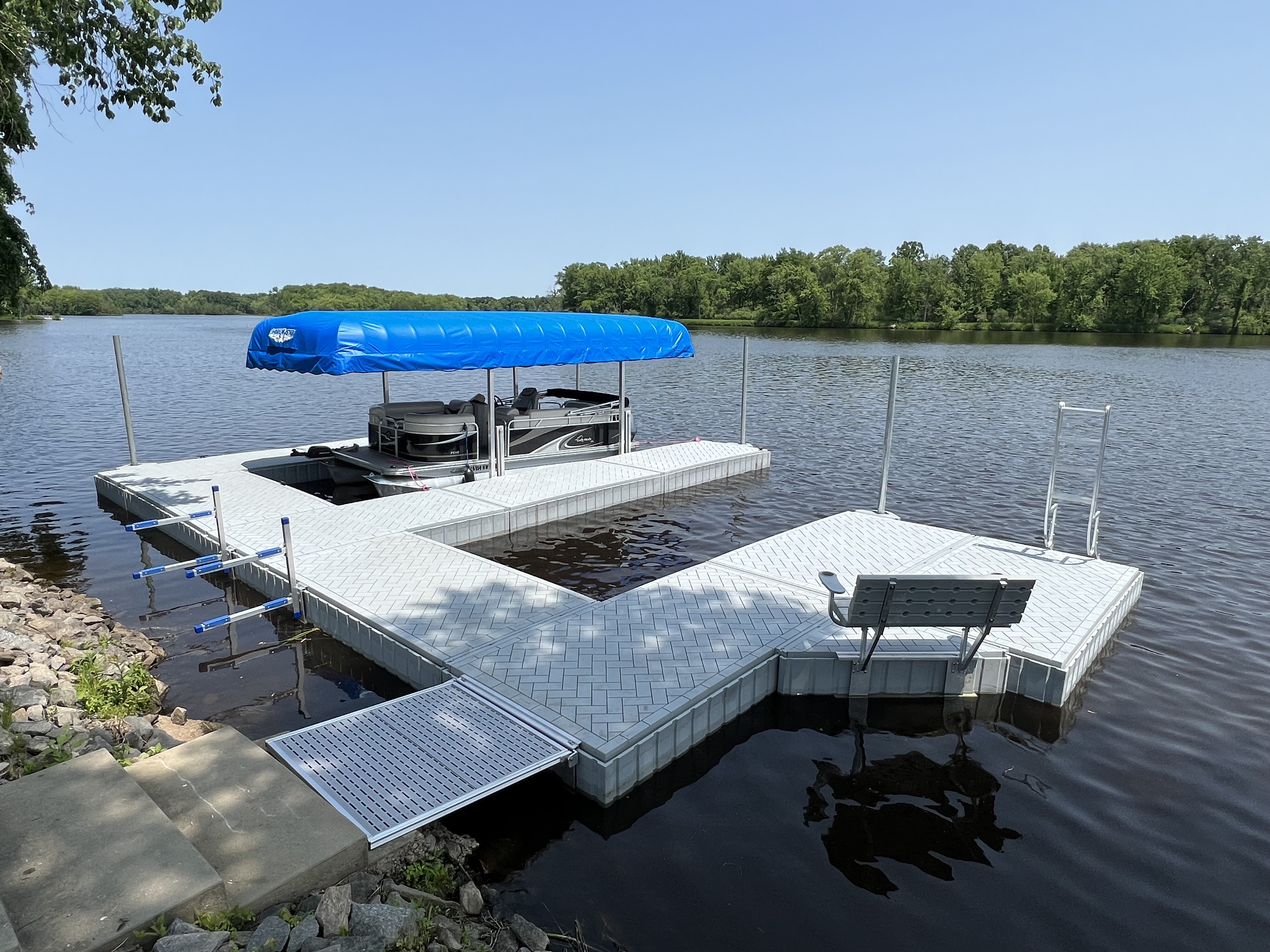
PolyDock uses independent, interlocking sections that fit together like building blocks. This simple yet innovative design, combined with different section sizes (including corner sections), makes it easy to create tailored layouts, whether for residential floating docks, commercial marinas, or municipal waterfront projects.
Engineered for Strength and Stability
Each PolyDock section is made from rotationally molded high-density polyethylene (HDPE). Rotational molding involves heating powdered resin inside a mold while slowly rotating it along two axes, so the material evenly coats the interior walls and forms a seamless part (RotoMoldUSA, n.d.). This results in durable, hollow plastic structures with superior impact resistance that don’t crack, warp, or rot – making it the perfect material for floating dock systems.
Meanwhile, the recessed areas at the bottom of each PolyDock section trap air between the dock and the water surface. This enhances the floating dock’s floatation capabilities, weight capacity, and stability. And unlike systems that rely on small, isolated brackets, our connectors span the seam of each section to lock them into a unified platform. This creates system-wide rigidity, ensuring your dock feels like a solid, single unit under your feet rather than a collection of bobbing rafts.
Design Your Perfect Dock Layout
With a range of section sizes (including 4’ x 6’, 3’ x 10’, 4’ x 10’, 5’ x 10’, 6’ x 8’, and 4’ corner sections) and a comprehensive catalog of accessories, PolyDock allows owners to create tailored layouts for virtually any waterfront application, from lake houses looking to extend their living spaces to marinas, campgrounds, and restaurants needing to expand their facilities.
Imagine having a dedicated slip for boat maintenance, a separate section for your jet skis, and a protected area for the kids and their water toys. Meanwhile, commercial establishments can create extra space for special events. Then, after the function, they can easily remove the floating dock sections and store them until the next one.
Easy to Install, Easier to Own
When Jim Vuocolo took over River Beach Campground and Marina in Mays Landing, NJ, they had old wooden docks, which they had to take out for winter storage. Aside from requiring more than 20 people to remove, the dock also required off-season repairs and even more upkeep by mid-summer. Today, River Beach boasts an 80-slip marina supported by over 90 PolyDock sections, all of which remain in the water year-round.
A standard residential configuration can typically be assembled in a single afternoon by two adults with basic hand tools. The modular sections float easily into position, and the connectors tighten down from the top, turning what used to be a major construction project into a manageable DIY task. We also offer several anchoring systems, including chain anchor plates, stiff arms, and pipe brackets, ensuring you can install PolyDock regardless of shoreline conditions.
“It’s virtually maintenance-free. It’s tough as nails,” Vuocolo says. “If you’re thinking about investing in a dock system, this is the way to go.”
Built to Last for Decades
PolyDock is specifically engineered to withstand challenging marine conditions in virtually any environment, from saltwater tidal zones to icy freshwater reservoirs. To achieve this, our polyethylene resin is infused with UV-8 inhibitors, which prevent fading and brittleness from prolonged sun exposure.
Meanwhile, each PolyDock section features a hydrophobic vent plug, allowing air pressure inside the dock’s hollow float chambers to equalize while preventing water from entering. This helps eliminate the ballooning effect resulting from changing climates and temperatures that can damage other flotation systems. We don’t usually recommend leaving floating docks in the winter, but this design feature works so well that a marina in Alaska leaves its PolyDock setup in the water year-round (Brinson Marine, 2023).
We’ve been manufacturing PolyDock and ShorePort since 1998, and you can still see many of those first dock sections in use today.
PolyDock vs. The Swiss Army Knife: A Fun Look at Versatility
It’s time we settle this once and for all. We’ll admit that little red multitool has its charms, especially when you’re all alone on the lakefront with a bottle of wine. But when it comes to real-world waterfront versatility, we can’t recommend PolyDock enough.
We still love the Swiss Army Knife – it’s compact and always becomes handy sooner or later. But when it comes to the water, PolyDock wins hands down.
How to Choose the Right Floating Dock System
Apart from the cost of a floating dock, selecting the right system starts with assessing the physical realities of your waterfront. Deep water, mucky lakebeds, or rocky terrain can make installing stationary pilings impossible, making a floating dock system with flexible anchoring options the only viable option. Stability is another crucial consideration, as you don’t want to feel like you’re balancing on a raft every time you carry a cooler aboard.
For many waterfront property owners, the required sweat equity is a critical factor. That’s why modern owners are moving away from wooden docks that require annual staining and sealing, favoring premium plastic docks that are easier to own. Similarly, if you need a dock for seasonal use, it must be easy to remove and reinstall. The ideal dock should maximize your time on the water, rather than requiring you to do work near it.
Keep in mind, floating docks are most suitable for small lakes and protected bays. If your waterfront is routinely exposed to boat wakes or large waves, a floating dock may not be the optimal solution.
Discover the PolyDock Difference
Ready to create your dream waterfront with one of the best docks for fluctuating water levels? Use the dealer locator tool below to get a list of authorized PolyDock dealers near you, or contact us today at (800) 328-8945 to discuss your requirements and discover the PolyDock difference.
FAQs
How long does a PolyDock last?
A PolyDock floating dock system is engineered to last for decades. Many of the first docks manufactured in 1998 are still in use today.
Can PolyDock handle changing water levels or waves?
Absolutely. Because it is a floating system, PolyDock automatically rises and falls with tidal changes or reservoir fluctuations, ensuring your freeboard height remains constant and your boat is always accessible. For rougher conditions, our full-length connectors provide system-wide rigidity to reduce swaying, while specialized anchoring (like pile hoops or stiff arms) keeps the dock secure in choppy water.
What accessories can be added?
The system features a recessed perimeter track that allows you to attach accessories anywhere along the dock edge without drilling into the plastic. This feature enables you to easily add, remove, and relocate dock accessories, including swim ladders, cleats, watersport racks, and benches.
Is installation truly DIY-friendly?
Yes, most standard residential configurations can be assembled in a single afternoon by two adults using basic hand tools. The sections are lightweight enough to maneuver, and the connectors are designed for intuitive assembly. These features turn what used to be a major construction project into a manageable weekend task.
How does PolyDock compare to aluminum or wood docks?
Unlike aluminum or wooden docks with separate frames, decking, and flotation systems, PolyDock utilizes modular high-density polyethylene sections that integrate the deck surface and flotation into a single, seamless unit.
This innovative design reduces the number of moving parts and potential points of failure. It also enables owners to design a layout that optimizes their shoreline space and expand or reconfigure as needs evolve.
References:
RotoMoldUSA (n.d.) What is Rotational Molding?
Brinson Marine (2023). Looking for Floating Dock? Why ShoreMaster Polydock might be the fit for you!


